
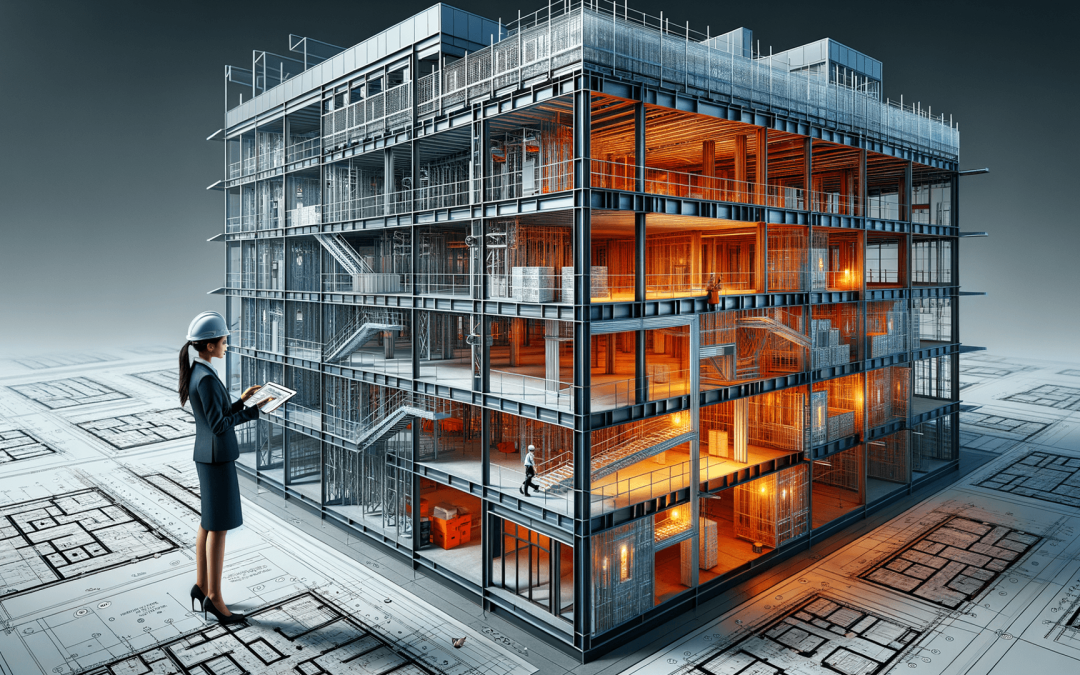
Fire-Rated Assemblies & Structural Impact: A Structural Engineer’s Guide to Commercial Buildings
Fire-rated assemblies do more than satisfy the building official—they drive fundamental choices in beams, decks, slabs, and connections. From the first sketches, a structural engineer evaluates how fire separations, fire-resistance ratings, and continuity rules affect the structural system. If you’re planning a new build or a major fit-out, it’s smart to hire a structural engineer early to align code strategy with cost, schedule, and performance.
What Drives Fire-Resistance Decisions?
Several intertwined code provisions determine how “fire” shapes structure:
- Construction type and occupancy: The International Building Code (IBC) sets minimum fire-resistance ratings for the primary structural frame, floor/roof assemblies, and shaft enclosures. More restrictive occupancies and higher-rise buildings typically demand higher ratings (e.g., 2-hour floors and frames for many mid/high-rise commercial projects).
- Fire-rated assemblies: Tested in accordance with ASTM E119/UL 263, these assemblies (walls, floors, roofs) must match a listed design—or be justified by engineering analysis where permitted.
- Continuity and supporting construction: Rated assemblies must be continuous, and the structure supporting them often needs an equal or greater rating. For example, the beam carrying a 2-hour corridor floor-ceiling assembly typically needs equivalent protection.
- Fire separations vs. fire walls: Fire barriers and horizontal assemblies create compartmentation within a single building; fire walls can separate buildings structurally, allowing each side to stand independently after a fire. This distinction changes how frames and connections are detailed.
- Joints and penetrations: Head-of-wall joints, perimeter slab edges, penetrations, and duct openings require tested systems (e.g., ASTM E1966 for joints, ASTM E814/UL 1479 for penetrations, ASTM E2307 for curtain wall perimeter fire barriers).
The result: fire ratings are not just a layer of gypsum or spray; they are a system decision that must be coordinated across architecture, MEP, and structure from day one.
Fire Separations 101: What They Mean for Structure
- Fire walls (structural independence): Often require the wall and foundations to remain stable if the structure on one side collapses. Frames on each side must not rely on the other for stability; collectors and diaphragms may terminate or be detailed with breakaway connections.
- Fire barriers (continuity): Must run from the floor to the floor or roof above, with rated joints and properly protected penetrations. Any beams or girders supporting a rated barrier or the floor that supports it typically need matching protection.
- Smoke barriers and partitions: Less stringent for structure but still require careful joint and penetration detailing.
- Horizontal assemblies: Floor/ceiling ratings (1–3 hours common) control slab thickness, composite action, deck profile, and beam protection method.
A structural engineer translates these code concepts into practical system choices and details that work in the field.
How Fire Ratings Influence Beam and Floor System Choices
1) Structural Steel Frames
- Protected vs. unprotected steel: In most commercial projects (Type I or II construction), primary structural steel requires fire protection. Options include:
- Spray-applied fire-resistive materials (SFRM): Cost-effective, adds dead load, needs substrate prep and humidity control. Thickness increases with longer ratings and higher section factors (W/D).
- Intumescent coatings: Clean finish for exposed steel; higher cost; sensitive to application conditions and damage.
- Board encasement (gypsum or calcium silicate): Predictable thickness, robust in high-traffic areas, but bulkier.
- Concrete encasement: Durable; increases member size and weight; pours and formwork affect schedule.
- Composite floor systems: Steel beams with composite metal deck and concrete topping are a staple. The fire rating depends on deck profile, slab thickness, concrete density, beam spacing, and reinforcement. Many UL designs achieve 2 hours with normal-weight concrete and minimal mesh, but cellular or deep decks may change the rating path.
- Beam selection: Deeper beams reduce quantity but can demand more SFRM (larger surface area). Shallow beams can drive heavier deck gauges or thicker slabs. Early modeling of beam size vs. fireproofing thickness can reveal the lowest total cost.
- Connections and continuity: Protected moment frames require careful fireproofing continuity at flanges and bolts. Braced frames may concentrate protection at gusset regions. Avoid leaving bolts and plates unprotected unless permitted by the listed design.
- Serviceability considerations: Additional fireproofing weight affects deflection and vibration checks; ensure camber and long-term deflection assumptions reflect fireproofing and finishes.
2) Cast-in-Place Concrete
- Inherent fire resistance: Concrete’s mass and thermal properties provide robust fire performance. Achieving 2-hour ratings can be straightforward with slab thickness and cover to reinforcement verified against code tables or recognized design guides.
- Flat plate vs. beam-and-slab: Flat plates are efficient but keep an eye on punching shear capacity at elevated temperatures; reinforcement detailing at columns may need enhancement for resilience.
- Lightweight vs. normal-weight concrete: Lightweight aggregates can perform well in fire tests but may have different structural properties; coordinate fire rating tables with structural design.
3) Precast Concrete and Hollow-Core
- Hollow-core planks: Commonly used for long spans. Fire ratings depend on topping thickness, strand cover, and joint details. Some planks meet 2 hours without topping; others require supplemental cover or mesh.
- Joints and continuity: Ensure grouted keys and topping interfaces match tested designs. Supporting beams or ledgers must be rated if they carry rated planks.
4) Mass Timber (CLT and Glulam)
- Char and encapsulation: Fire ratings may rely on sacrificial char layers or gypsum board encapsulation. IBC Type IV-A/IV-B/IV-C prescribe encapsulation strategies, concealed space limitations, and connection protection.
- Connections: Protect steel hangers, screws, and plates within the char layer or with additional encasement. Exposed steel connectors often require intumescents or cover plates.
- Hybrid systems: Timber floors over steel frames may shift fire protection to the steel. Evaluate whether encapsulating wood or protecting steel yields a better cost and schedule outcome.
Details That Make or Break Compliance
- Head-of-wall joints: Use listed joint systems compatible with expected beam/joist deflections and building drift. A beautiful rated wall fails if the joint cracks open under movement.
- Perimeter slab edges and curtain walls: Provide tested perimeter fire barrier systems with spandrel insulation and safing; coordinate curtain wall anchors to avoid compromising continuity.
- Penetrations and MEP coordination: Require listed firestop systems for each penetrating item (pipes, conduits, cable trays). Group penetrations where possible to simplify rated assemblies and inspections.
- Supporting construction: If a 2-hour floor spans to a transfer girder, that girder needs equivalent protection. Watch for misalignments where rated walls stack over nonrated beams.
- Stairs and shafts: Enclosures need continuous ratings. Don’t route beams through shafts without an approved rated assembly and penetrations strategy.
- Deflection compatibility: Gypsum encasements and joint systems have deflection limits; verify beam camber, live load deflection, and thermal movement to avoid cracking and failures.
- Field-friendly specs: SFRM adhesion and thickness verification, intumescent dry film thickness checks, and board fastener spacing must be clear and practical. Provide inspection hold points.
Real-World Scenarios and Strategies
- Mid-rise office, Type I-B, 2-hour floors:
- Option A: Composite steel with 2.5–3.5 in concrete over deck, SFRM on beams/columns. Economical but messy sequencing; enclose sensitive areas before spraying.
- Option B: Flat plate concrete slab with column capitals. Cleaner finishes, inherent rating, possibly longer cycle times and heavier structure.
- Option C: Mass timber with encapsulation for 2-hour rating. Warm aesthetic where exposed wood is allowed; careful planning for connectors and MEP routing.
- Retail with tenant turnover:
- Reduce future fit-out friction by standardizing penetration firestop details and providing spare shaft capacity.
- Protect transfer girders supporting rated corridors to avoid rework when tenants add openings.
- Renovation of legacy buildings:
- Verify existing assembly ratings with probes and documentation. If the old assembly doesn’t match a current listing, develop an engineering judgement or overlay solutions (e.g., add board encasement or increase slab cover).
- Strengthen where needed but watch that new steel receives proper fire protection without creating conflicts with historic finishes.
Cost, Weight, and Schedule: Trade-Offs to Expect
- SFRM: Lower material cost, added weight, careful environmental controls, and potential overspray cleanup.
- Intumescent coatings: Highest finish quality for exposed steel; higher cost, more sensitive schedule.
- Board encasement: Predictable, rapid inspection; increased bulk can clash with ceiling plenum space.
- Concrete solutions: Often simplest for rating; heavier structure can affect foundations and seismic forces.
- Timber: Potentially faster erection and reduced weight; detailed coordination for rating continuity and connections is essential.
A structural engineer will run comparative studies that include not only member quantities but also fireproofing thickness, inspection complexity, erection sequencing, and long-term maintenance.
When to Engage a Structural Engineer—and What to Ask
Engage early, ideally at concept design, to lock in the right rating strategy with the right system. Ask:
- What are the minimum ratings for our construction type, height, and occupancy?
- Which floor/beam systems meet those ratings most economically?
- How will fire walls or long fire barriers affect frame layout and diaphragm continuity?
- What’s our plan for joints, penetrations, and the perimeter slab edge?
- Can we reduce ratings through alternate approaches (e.g., sprinklers, compartmentation, or performance-based design) where permitted?
- How will choices affect total dead load, drift, vibration, and acoustics?
If you’re navigating these decisions now, hire a structural engineer to align code compliance with structural efficiency and architectural intent.
Key Takeaways
- Fire ratings are a system decision, not a finish. They influence beam sizes, slab thickness, and connection types.
- Supporting structure often needs the same rating as the assembly it carries.
- Joints, penetrations, and perimeter conditions are as critical as the wall or slab itself.
- Steel, concrete, and mass timber can all meet 1–3 hour ratings; cost, schedule, and aesthetics drive the optimal choice.
- Early coordination with a structural engineer reduces change orders and accelerates approvals.
Conclusion
Fire-rated assemblies are inseparable from structural strategy in commercial buildings. By integrating code requirements with practical system selection—steel with SFRM or intumescent, concrete with inherent resistance, or mass timber with char and encapsulation—you can achieve compliance without sacrificing cost or design vision. The best path forward is an early, data-driven comparison led by a structural engineer who can translate code into constructible, economical details.
Q1: What are fire-rated assemblies in commercial buildings, and why do they matter structurally? A1: A fire-rated assembly is a tested wall, floor, or roof system with a specified fire-resistance duration (e.g., 1–3 hours) per ASTM E119/UL 263. Ratings affect supporting construction, so beams, slabs, and connections must match or exceed requirements. A structural engineer aligns these choices with code, cost, schedule, and aesthetics.
Q2: How do fire separations influence beam and floor system choices? A2: Fire separations drive system selection by dictating the rating of the floor/ceiling and the beams that support it. Composite steel may need SFRM or intumescent coatings; concrete slabs rely on thickness and cover; mass timber uses char or gypsum encapsulation. Deck profiles, beam depth, and spacing change to satisfy listed designs.
Q3: What are the main fireproofing options for structural steel, and what are the trade-offs? A3: Common options include SFRM (cost‑effective but adds weight and requires environmental controls), intumescent coatings (clean aesthetics, higher cost), board encasement (predictable, bulkier), and concrete encasement (durable, heavy). Trade‑offs span cost, finish quality, schedule, and inspection complexity. A structural engineer balances member sizing with protection thickness to minimize total cost.
Q4: How do fire walls, fire barriers, and horizontal assemblies affect structural design? A4: Fire walls require structural independence, so each side must stand if the other collapses; diaphragms and collectors may terminate or use breakaway connections. Fire barriers demand continuity, with supporting beams carrying equal or greater ratings. Horizontal assemblies control floor/ceiling ratings, influencing slab thickness, deck selection, beam sizing, and tested joints.
Q5: What details most often cause fire-rating failures, and how can a structural engineer prevent them? A5: Avoid failures at head‑of‑wall joints, perimeter slab edges, and penetrations by using listed systems compatible with expected deflection and drift. Protect supporting members to the same rating as the assemblies they carry, and coordinate stair and shaft continuity. A structural engineer standardizes details, sequences inspections, and aligns MEP penetrations early.
Q6: When should I hire a structural engineer for fire-rated design, and what should I ask? A6: Hire a structural engineer at concept design to lock ratings into system choices. Ask about minimum code ratings by type and height, optimal floor/beam systems, impacts of fire walls on diaphragm continuity, joint and perimeter strategies, and whether sprinklers or performance-based design can reduce ratings while maintaining safety and budget.
Q7: What are the cost, weight, and schedule trade-offs among fire-rated systems? A7: SFRM is inexpensive but adds dead load and requires controlled conditions; intumescents cost more yet deliver a clean exposed look; board encasement is predictable but bulky; concrete offers inherent resistance with heavier frames; mass timber speeds erection but needs encapsulation. Comparative studies quantify totals, not just member weight or protection thickness.