
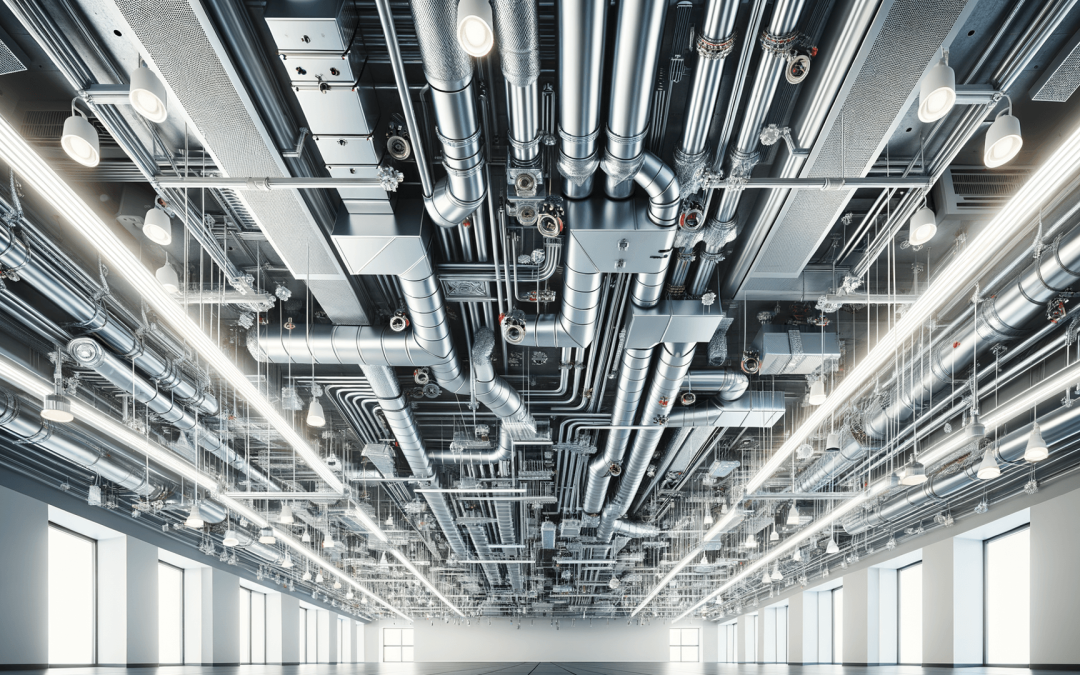
Ceiling Loads You Didn’t Plan For: A Structural Engineer’s Guide to Hanging HVAC, Signage, Lighting, and Speakers
Commercial interiors often change faster than the base building structure: tenants add HVAC units, branding signage, lighting features, and speakers long after the shell is complete. The catch is that ceilings are not blank canvases. Every suspended item creates load paths, vibrations, and lateral forces the building must safely resist. This is exactly where a structural engineer adds value—by verifying capacity, detailing connections, and designing bracing that keeps people safe and projects code-compliant. Before you drill, clamp, or “make it work,” know how to plan, design, and coordinate hanging equipment the right way—and when to hire a structural engineer.
Why Ceiling Loads Get Overlooked
- Assumptions about “extra” capacity: Tenants assume the ceiling or roof can take anything small or lightweight without verification.
- Hidden structure: Fireproofing, ceilings, and ductwork conceal beams, joists, and deck types, making guesswork tempting.
- Small loads that add up: One track light is light; 200 feet of track with pendants, cable trays, and signage isn’t.
- Last-minute adds: AV, branding, and retail elements often land after MEP and structure are set—leaving limited options for safe attachments.
Skipping the structural step can lead to cracked slab edges, overloaded bar joists, popped anchors, damaged ceiling grids, and, worst of all, safety hazards.
Know Your Structure Before You Hang
Identifying the base structure and ceiling system sets the rules of engagement for any suspended load.
- Steel bar joists + metal deck: Common over retail and office cores. Good for vertical loads at panel points; sensitive to unplanned torsion and concentrated loads between panel points.
- Steel beams + metal deck: Provides stronger framing zones; best to connect near beam webs or flanges using approved anchors or clamps.
- Cast-in-place concrete slab: Can take anchors if thickness, reinforcement, and edge distances are verified. Post-tensioned slabs demand special caution and scanning to avoid tendons.
- Precast hollow-core plank: Limited top/bottom concrete cover and voids restrict anchor sizes and capacities—special anchors and detailing required.
- Wood joists/trusses: More common in smaller commercial or retrofit spaces; connections must preserve member capacity and avoid splitting.
- Suspended grid ceilings (T-bar): Not a structural support. Ceiling wires are for the ceiling only; anything heavier than a small trim kit requires independent hangers to structure.
Pro tip: Document the existing structure with as-built drawings, field verification, and scanning. When in doubt, hire a structural engineer to map load paths and validate attachment strategies.
What Are You Hanging? Typical Loads and Tricky Effects
- HVAC units and air handlers: 150–800+ lb each; add 10–25% for vibration isolators hardware and service platforms.
- Ductwork and accessories: 3–8 lb/ft for typical sizes; diffusers, dampers, and insulation add more; long runs require lateral bracing.
- Signage: 50–500+ lb depending on materials and size; large signs attract lateral loads from air movement or door drafts.
- Lighting: Track lighting around 2–4 lb/ft; pendants 10–50 lb each; feature fixtures can exceed 150 lb and may need multi-point support.
- Speakers and clusters: 20–120 lb each; subwoofers and arrays can exceed 100–500 lb; dynamic forces from vibrations matter.
Don’t forget non-vertical forces:
- Vibration from mechanical equipment and audio systems
- Lateral forces from seismic events or strong air currents
- Dynamic amplification for moving components (e.g., fans)
Bracing Strategies That Work
HVAC: Heavy Loads and Constant Vibration
- Load path first: Use trapeze frames (Unistrut or structural steel) with threaded rods directly to structure—not to grid ceilings.
- Isolators and snubbers: Spring or neoprene vibration isolators limit transmission; seismic snubbers restrain movement during an event.
- Lateral bracing: Provide transverse and longitudinal braces for equipment and long duct runs per SMACNA seismic guidelines where applicable.
- Anchor selection: Use code-listed mechanical or adhesive anchors with cracked-concrete and seismic approvals as required by the jurisdiction. Observe edge distances and embed depths.
- Bar joists: Favor panel points for connections. If between panel points, confirm joist capacity for local loads and torsion. Supplemental joist reinforcement may be required.
- Coordination: Maintain clearance from sprinklers and accommodate differential movement between ducts, isolators, and structure.
Signage: Redundancy and Distribution
- Redundant supports: Use dual independent hangers with rated hardware and a continuous secondary safety (cable or chain).
- Spread the load: Distribute to multiple joists or beams using spreader bars or frames; avoid eccentric loads that twist members.
- Lateral and torsional restraint: Provide splay cables or struts to prevent swing. Large signs near entrances may see wind gusts—design for lateral loads.
- Materials matter: Use listed rigging hardware (forged eyebolts, shackles, wire rope clips) with documented capacities; avoid hardware-store eye screws.
- Access for maintenance: Include locknuts, turnbuckles, and inspection points.
Lighting: Code, Heat, and Independent Supports
- Never hang from T-bar: Provide separate hangers to structure for tracks and heavy pendants; use listed grid clamps only for the grid itself as permitted by code.
- Heat and spacing: Maintain clearances from combustible surfaces and sprinklers; verify NEC and manufacturer spacing requirements.
- Long runs: Add periodic lateral bracing to limit sway; consider cable trays or strut systems to offload wiring weight.
- Feature fixtures: For heavy chandeliers or clusters, design a dedicated support frame tied to beams or joists with multiple points and a secondary safety.
Speakers and AV: Dynamic Loads and OEM Hardware
- OEM rigging points only: Use manufacturer-rated eyebolts, frames, or flyware; never drill ad hoc holes in speaker cabinets.
- Redundant safety: Always include a secondary safety cable sized to the full load.
- Arrays and clusters: Use engineered frames that balance loads across multiple hang points; check building drift compatibility.
- Vibration control: Isolate where needed, but include seismic restraint if required by code. Verify that isolators don’t compromise lateral stability.
Seismic, Wind, and Vibration Considerations
- Codes and standards: The IBC and ASCE 7 require nonstructural components to be anchored and braced based on seismic design category and risk.
- Lateral bracing: Provide bracing in two orthogonal directions and for vertical restraint; design slotted or flexible connections where differential movement is expected.
- Building drift: Hanging systems must tolerate story drift without overstressing rods or frames; consider splayed bracing and flexible links.
- Wind and air movement: Large, lightweight items (signs, baffles, acoustic clouds) need lateral restraint to prevent oscillation.
- Don’t mix systems: Avoid rigidly tying to two different structural frames that move differently under load unless engineered for compatibility.
Process, Permitting, and Special Inspection
- Site survey: Verify structure type, member locations, fireproofing thickness, and conflicts with MEP and sprinklers.
- Calculations and drawings: Prepare stamped calculations and shop drawings for supports, anchors, and bracing as required.
- Anchor approvals: Use code-listed anchors with evaluation reports appropriate for the base material and seismic category.
- Special inspection: Adhesive and some mechanical anchors in concrete often require special inspection or on-site proof testing; plan for it.
- Close-out and maintenance: Provide torque specs, inspection intervals, and a log for periodic checks—especially for vibration-heavy systems.
When in doubt—or whenever loads are significant, clustered, or seismically governed—hire a structural engineer early. It’s almost always cheaper to design supports before ceilings are closed than to retrofit them after occupancy.
Red Flags That Require Immediate Attention
- Hangers attached to ceiling grid wires or tees
- Single-point suspensions for heavy or asymmetrical loads
- Missing secondary safeties on signage or speakers
- Anchors near slab edges, cracked concrete, or unknown post-tensioned zones
- Bar joist connections away from panel points without verification
- Long, unbraced runs of duct, track lighting, or cable tray
- Vibration isolators installed without lateral restraint
- No documentation of anchor type, capacity, or inspection
Budget and Timeline Tips
- Design allowance: Include a line item for engineered supports and seismic bracing in tenant-improvement budgets.
- Lead times: Specialty anchors, isolators, and rigging hardware can have lead times—order early.
- Field flexibility: Use adjustable systems (Unistrut, turnbuckles, slotted connections) to accommodate real-world tolerances.
- Coordination meetings: Align structure, MEP, AV, and sprinkler layouts before rough-in to avoid rework.
A Quick Pre-Hang Checklist
- Identify base structure and confirm capacity.
- Choose the right anchors with code approvals for the substrate.
- Provide a continuous load path with redundant supports where appropriate.
- Add lateral bracing for seismic, wind, or air-movement effects.
- Keep independent supports for grid ceilings; maintain code clearances.
- Document torque, inspection, and maintenance procedures.
- If uncertain at any step, hire a structural engineer.
Conclusion
Hanging equipment in commercial spaces seems simple—until you account for real load paths, lateral forces, vibration, and code requirements. The safest, most cost-effective approach is to plan supports as part of design, not as a field workaround. Whether you’re suspending HVAC, branding signage, custom lighting, or speaker arrays, involve a structural engineer to verify capacities, engineer anchors and bracing, and streamline approvals. Doing so protects your project, your budget, and, most importantly, the people beneath it.
Q1: What are ceiling loads in commercial spaces, and why involve a structural engineer? A1: Ceiling loads are the combined forces from suspended HVAC, ductwork, signage, lighting, and speakers. They introduce vertical, lateral, and vibration demands into joists, beams, or slabs. A structural engineer confirms capacity, load paths, and connections so incremental additions don’t cause overloads, failures, or safety risks in occupied areas.
Q2: When should I hire a structural engineer to hang HVAC, signage, lighting, or speakers? A2: Hire a structural engineer when loads are heavy or clustered, attach to bar joists between panel points, approach slab edges, involve post‑tensioned concrete, or fall in seismic regions. Also engage one for feature lights, large signs, anchor design, code submittals, and inspections to avoid costly rework and delays.
Q3: How do I identify the structure above my ceiling and choose safe attachment points? A3: Start with as‑builts, field verification, and scanning. Determine if you have steel bar joists with metal deck, steel beams, cast‑in‑place or post‑tensioned slabs, or precast hollow‑core. Never use ceiling grid wires. Favor joist panel points and beam webs. Verify concrete thickness and reinforcement. A structural engineer validates locations.
Q4: What are best practices for bracing HVAC equipment and ductwork from the ceiling? A4: Use trapeze frames (Unistrut or steel) with threaded rods to structure, not T‑bar. Add vibration isolators and seismic snubbers. Brace ducts longitudinally and transversely per SMACNA. Select anchors with seismic approvals, correct embedment, and edge distances. Coordinate sprinkler clearances and maintain service access for filters, coils, and belts.
Q5: How should signage, lighting, and speakers be safely hung and braced? A5: Provide redundant supports with secondary safety cables for signage and speakers. Distribute loads via spreader bars and add splay cables to control sway. Avoid using grid for lighting; install independent hangers. Heavy feature fixtures often need dedicated frames and multi‑point connections. Use listed OEM rigging hardware and documentation.
Q6: What seismic, wind, and inspection rules apply to hanging equipment and anchors? A6: IBC and ASCE 7 require anchorage and bracing for nonstructural components. Provide vertical restraint and bracing in two directions, accounting for drift and differential movement. Control wind or air‑current sway for large, light elements. Adhesive and cracked‑concrete anchors often need special inspection or proof testing in higher seismic categories.
Q7: What red flags mean my ceiling installation is unsafe and I should hire a structural engineer? A7: Red flags include hangers on grid wires, single‑point supports for heavy or uneven loads, anchors near slab edges or unknown post‑tension zones, and unbraced long runs. Missing secondary safeties or isolators without lateral restraint also signal risk. If seen, stop work and hire a structural engineer immediately.