
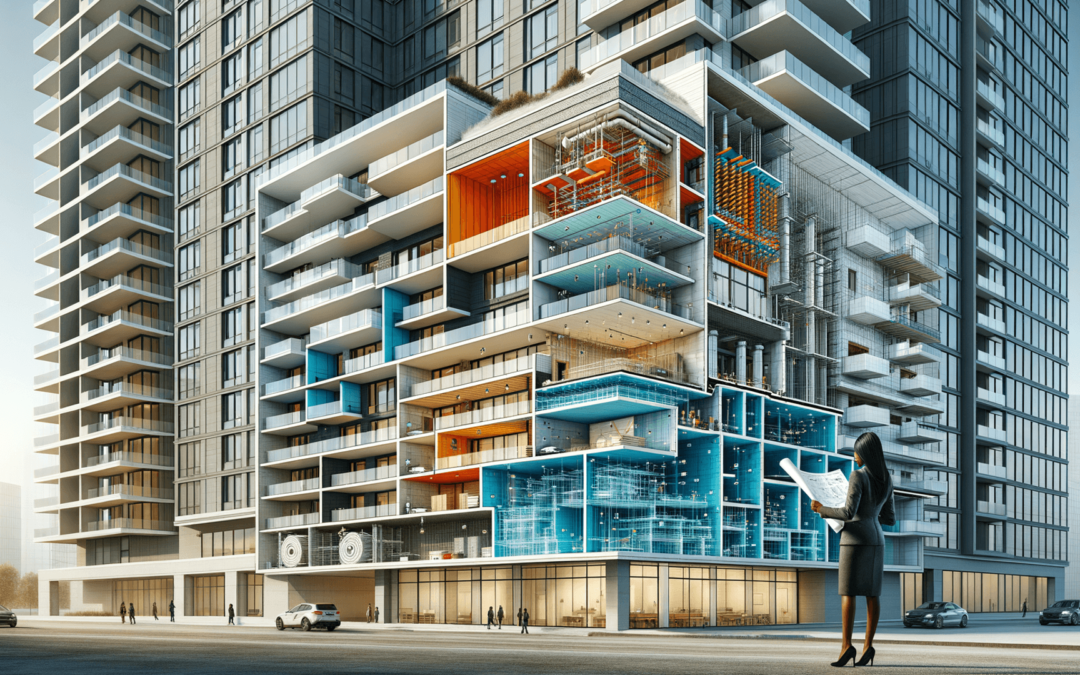
Balconies, Thermal Breaks, and Long-Term Durability in Multi-Family Buildings: A Structural Engineer’s Guide
Balconies define the lifestyle and market appeal of multi-story condos and apartments—but they also concentrate risk. From thermal bridges that sap energy and spawn condensation to corrosion that compromises safety, a balcony is where envelope and structure collide. A structural engineer is central to resolving these competing demands. Whether you’re planning a new project or managing an existing one, knowing when to hire a structural engineer can be the difference between decades of trouble-free performance and costly, disruptive repairs.
The Balcony Challenge in Multi-Family Housing
In multi-family buildings, balconies must simultaneously:
- Carry gravity, wind, and occupancy loads without excessive deflection or vibration.
- Resist water, freeze-thaw cycles, and chloride intrusion that can corrode reinforcement and anchors.
- Maintain the building’s thermal and air barrier continuity to control energy loss and condensation.
- Provide durable anchorage for guardrails and finishes.
- Satisfy evolving energy, fire, and structural codes.
Neglecting any one of these can shorten service life. Structural engineering input at design—and proactive inspection during operations—keeps performance balanced across all disciplines.
Thermal Bridges 101: Why Slab Edges Matter
A thermal bridge is a high-conductivity pathway that lets heat bypass insulation. At balconies, the most common thermal bridge occurs where a concrete floor slab extends outdoors. Consequences include:
- Increased heating and cooling demand.
- Cold interior surfaces at slab edges that can trigger condensation and mold.
- Discomfort near exterior walls and doors.
- Accelerated deterioration: moisture plus cycling temperatures amplify cracking, spalling, and reinforcement corrosion at the transition.
Energy codes increasingly target these losses. Detailing to interrupt heat flow—without compromising structural capacity—is now standard practice in high-performance multi-family buildings.
Common Balcony Systems and Their Risks
- Cantilevered concrete slab
- Pros: Simple geometry, solid feel, direct load path.
- Risks: Severe thermal bridging at the slab extension; rebar corrosion and spalling if water migrates inward; challenging balcony-to-wall air/water transitions.
- Steel bolt-on or hung balcony
- Pros: Reduced slab edge thermal bridging; easier retrofit; prefabrication potential.
- Risks: Thermal bridging through steel fins or ledgers; corrosion of steel and fasteners; vibration and serviceability complaints if undersized; careful fireproofing and separation needed at penetrations.
- Precast or bracket-supported balcony
- Pros: Factory-controlled quality; replaceable modules; potential to simplify envelope continuity.
- Risks: Anchorage complexity; waterproofing at bearing points; differential movement between precast and main structure.
- Roof terraces over living space
- Pros: Amenity and usable area without overhanging structure.
- Risks: Waterproofing continuity at door thresholds; slope and drainage; load increase from planters and pavers; guardrail anchorage that does not puncture membranes.
Each system can succeed with careful detailing. The key is integrating structure, envelope, and MEP needs from day one.
Thermal Break Solutions and How They Work
- Thermally broken balcony connectors
- Description: Engineered assemblies with insulation sandwiched between the interior slab and exterior balcony, coupled by high-strength bars or plates that carry tension, compression, and shear.
- Benefits: Continuity of insulation; reduced interior condensation risk; measurable energy savings; less risk of freeze-thaw damage at slab edges.
- Considerations: Verified fire resistance; sufficient shear/tension capacity; deflection control; coordination with rebar congestion; compatibility with firestopping and edge forms.
- Stand-off ledgers and thermal pads
- Approach: Separate steel ledgers from the wall with structural thermal pads to reduce conductive heat transfer.
- Considerations: Fastener design for combined shear/tension; water management around anchors; corrosion protection of steel and fixings.
- Independent framing or posts
- Approach: Support balconies on columns or brackets that bypass the floor slab, eliminating direct penetrations of the thermal envelope.
- Considerations: Architectural integration at ground or podium; vibration control; support footings and waterproof transitions at the building face.
- Continuous exterior insulation alignment
- Coordinating the balcony connection so insulation remains continuous at the wall and slab edge avoids cold spots and messy transitions. A structural engineer helps ensure that shifting the support line to preserve the insulation plane does not create unanticipated eccentricities or slab edge failures.
Waterproofing and Drainage: The First Line of Defense
Water gets in where details are weakest. Priorities include:
- Positive slope: Minimum 1/4 inch per foot away from the building to shed water, not trap it at thresholds.
- Continuous membranes: Select systems (liquid-applied, sheet, or PMMA) compatible with traffic and UV exposure; protect them with wear layers or pavers on pedestals.
- Door thresholds and transitions: Pan flashing, back dams, and sill details that do not rely on sealant alone.
- Penetration control: Avoid railing post penetrations through membranes; use side-mounted guards or stand-offs with fully sealed bases and weeps where needed.
- Drip edges: Prevent water from clinging to soffits and migrating back to the wall.
- Movement joints: Provide breaks in tile or stone finishes, as well as elastomeric transitions at slab edges, to handle thermal and structural movement.
- Drainage path: Avoid ponding; include surface drains where needed and keep scuppers clear.
A structural engineer collaborates with the envelope consultant to set deflection limits that protect the waterproofing and prevent ponding that accelerates deterioration.
Corrosion and Material Choices That Extend Service Life
- Reinforced concrete
- Use low water-cement ratio mixes and supplementary cementitious materials to reduce permeability.
- Provide adequate cover over reinforcement; specify epoxy-coated or stainless bars in high-exposure zones (salt spray, deicing chemicals).
- Detail drip grooves on slab edges; avoid trapped water.
- Consider corrosion inhibitors or, in extreme environments, cathodic protection.
- Steel and fasteners
- Hot-dip galvanizing, duplex coatings (galvanizing plus paint), or stainless steel for high-exposure anchors and rails.
- Match fastener metals to surrounding materials to avoid galvanic corrosion.
- Seal fastener penetrations; detail accessible replacement where lifecycle maintenance is expected.
Selecting appropriate materials with a structural engineer prevents early failures and reduces lifecycle costs.
Structural Detailing for Performance and Comfort
- Load paths and anchorage
- Verify balcony-to-structure connections for combined shear, tension, and prying.
- Check edge distances and concrete breakout capacities in accordance with anchor standards.
- For thermally broken connectors, confirm shear friction and punching shear capacity at the slab-interface.
- Deflection and vibration control
- Set serviceability limits to protect membranes, tile, and glass railings from cracking.
- For steel balconies, tune stiffness to minimize perceptible bounce under foot traffic.
- Differential movement
- Resolve movements between main structure, balcony, cladding, and rails. Include slip details at interfaces so waterproofing and finishes survive thermal cycles.
- Guardrail safety
- Design rails for code-prescribed line loads and infill; confirm anchorage into structural members, not cladding or topping alone.
Inspection, Maintenance, and Reserve Planning
For existing condos and apartments, plan a structured program:
- Inspection intervals
- At turnover/one year: Baseline photos and punch-list of waterproofing and rails.
- Every 3–5 years: Visual survey for cracks, rust staining, spalls, loose railings, membrane wear, and ponding.
- At 10-year milestones or after severe weather: Add selective non-destructive testing (cover meter, GPR) and targeted probes.
- Early warning signs
- Rust stains below slab edges; hollow-sounding concrete; efflorescence; soft sealants; loose or wobbly rails; interior moisture or cold spots near slab edges.
- Maintenance actions
- Renew sealants at expected lifespans; recoat steel; repair spalls and cracks; replace worn membranes; keep drains clear; avoid deicing salts that attack concrete and metals.
- Budgeting and reserves
- Include balcony membranes, railings, coatings, and anchor replacements in long-term capital plans. A structural engineer can scope priorities, sequencing, and unit costs for reserve studies.
When to Hire a Structural Engineer
Bring in a professional early and often—during design and throughout the building’s life. Consider engaging one if you observe or plan for:
- New projects requiring thermally broken connectors or complex anchorage details.
- Renovations, balcony replacements, or upgrades to meet current energy or structural codes.
- Visible cracking, spalling, rust staining, or exposed rebar.
- Loose or corroded guardrails, or glass breakage.
- Excessive deflection, noticeable bounce, or unusual creaking.
- Water leaks at balcony doors or ceilings below.
- Persistent interior condensation at slab edges or high energy bills.
To protect safety, value, and energy performance, hire a structural engineer with multi-family experience and a track record of balcony and envelope coordination.
A Brief Case-In-Point
A mid-rise apartment building experiencing winter condensation along interior slab edges opted to retrofit with thermally broken steel ledger pads and replace failing tile over a new fully adhered membrane. The design team tightened serviceability limits to protect finishes and added drip edges to new balcony fascias. Within the next heating season, residents reported improved comfort at living room doors, maintenance noted no further leaks, and reserve planning pivoted from emergency repairs to scheduled coating renewals. The integrated approach—structure plus envelope—reset the building’s durability trajectory.
Actionable Checklist for Developers and Property Managers
- Select a balcony system early and coordinate structure, envelope, and MEP around it.
- Use thermally broken connectors or strategies that keep insulation continuous.
- Set deflection and vibration limits aligned with finish durability.
- Detail waterproofing at thresholds, penetrations, and edges with positive slope and drip control.
- Choose corrosion-resistant materials and compatible fasteners.
- Keep rails anchored to structure, not finishes; avoid membrane punctures.
- Establish inspection and maintenance cycles; document conditions with photos.
- When in doubt, hire a structural engineer to validate assumptions and prevent costly rework.
Conclusion
Balconies are high-stakes features in multi-story condos and apartments. The right combination of thermal breaks, robust waterproofing, and thoughtful structural detailing preserves safety, comfort, and value for decades. Early integration—and timely evaluation during operations—pays for itself many times over. If your project is moving from concept to drawings, or your property shows signs of distress, hire a structural engineer to guide decisions that balance energy performance and long-term durability.
Q1: What are the biggest balcony challenges in multi-story condos and apartments? A1: Balconies in multi-story condos must carry gravity and wind loads, resist water and freeze-thaw, maintain continuous thermal and air barriers, and anchor safe guardrails—all while meeting evolving codes. Neglecting any element leads to corrosion, cracking, and leaks. Early coordination with a structural engineer balances durability, energy performance, and comfort.
Q2: What is a thermal bridge at a balcony, and why do thermal breaks matter? A2: A thermal bridge occurs where heat bypasses insulation—commonly at slab edges that extend into a balcony. Without thermal breaks, interiors suffer cold spots, condensation, and mold, while energy bills rise and edges deteriorate faster. Installing thermally broken connectors preserves insulation continuity and reduces moisture risks without sacrificing structural capacity.
Q3: How do thermally broken balcony connectors work in multi-family buildings? A3: Thermally broken balcony connectors sandwich rigid insulation between interior slab and exterior balcony, linking them with high‑strength bars or plates for shear, tension, and compression. To perform, verify load capacity, deflection limits, fire rating, and coordination with rebar and firestopping. A structural engineer ensures code compliance and constructability.
Q4: What waterproofing and drainage details extend balcony life? A4: Long-lasting balconies start with water management: 1/4 in‑per‑ft slope away from doors, continuous traffic-rated membranes, pan flashing and back dams at thresholds, drip edges, and movement joints in finishes. Avoid puncturing membranes with railing posts; side-mount guards instead. Proper deflection limits prevent ponding—coordinate criteria with a structural engineer.
Q5: When should a condo board hire a structural engineer for balconies? A5: Hire a structural engineer when you see cracks, spalling, rust stains, loose or corroded guardrails, excessive bounce, leaks at balcony doors, or persistent interior condensation at slab edges. They’ll assess anchor capacities, waterproofing failures, and thermal bridges, then prioritize repairs or upgrades to protect safety, value, and energy performance.
Q6: What inspection and maintenance plan keeps condo balconies durable? A6: Set a program: baseline inspection at turnover, visual surveys every 3–5 years, and deeper testing each decade or after severe events. Maintain sealants, membranes, and coatings; clear drains; avoid deicing salts. Document conditions with photos and plan reserves. A structural engineer can scope repairs, sequencing, and realistic lifecycle costs.