
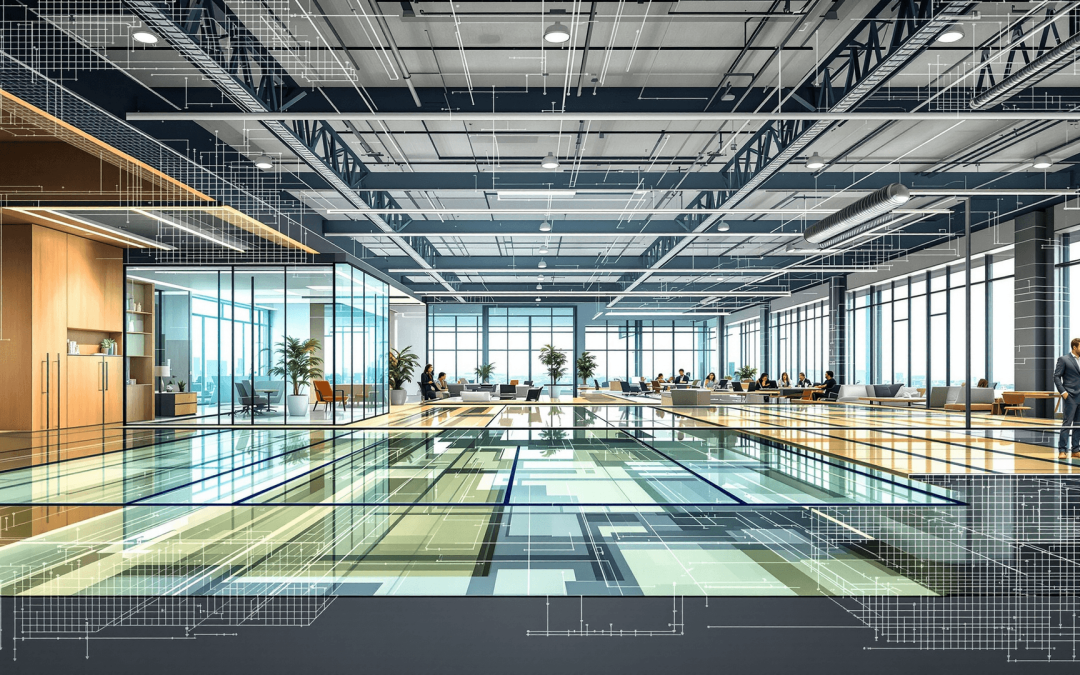
The modern office is in flux, and flexible workspaces are now a strategic advantage. Whether you’re planning a new headquarters or reimagining an existing floor plate, a structural engineer is central to making adaptability safe, efficient, and durable. From raised floors and movable partitions to column-free layouts, the structural system sets the limits for how easily a space can evolve with your teams and technology. Below, we explore the core structural decisions that future-proof offices—and when to hire a structural engineer to guide them.
The Business Case for Flexibility
Work patterns change faster than leases. An office that can morph without major disruption reduces churn, downtime, and waste. Flexibility pays off when:
- Teams reorganize and need different adjacencies
- Technology upgrades demand new cabling routes or power layouts
- Tenants shift headcount, requiring denser or more open plans
- Meeting rooms, focus areas, and collaboration zones need rebalancing
The right structural blueprint supports these shifts without invasive demolition. Three strategies—raised floors, movable partitions, and column-free layouts—form the foundation.
Raised Floors: Hidden Infrastructure, Visible Agility
Raised access floors (RAF) create a serviceable plenum for power, data, and sometimes underfloor air distribution (UFAD). They allow plug-and-play reconfigurations with minimal dust, noise, or downtime.
Key structural considerations:
- Loads and stiffness: Standard office floor panels handle typical walking loads, but not concentrated loads from safes, library stacks, heavy filing, large printers, or server racks. A structural engineer will verify panel ratings, pedestal capacity, and overall floor stiffness to prevent bounce, rattles, or panel damage under rolling loads. Heavy items should bypass the raised floor and bear directly on the structural slab via localized supports.
- Floor height and accessibility: Common RAF heights range from 4 to 18 inches. Taller voids increase service capacity but affect floor-to-floor heights, thresholds, and ADA transitions. Ramps and edge detailing must be planned at elevators, stairs, and core interfaces.
- Fire and life safety: Firestopping around penetrations, compliant perimeter detailing, and alignment with the building’s fire strategy are essential. If the plenum carries air (UFAD), materials must meet stringent fire and smoke standards.
- Acoustics and sealing: Airtight underfloor compartments improve HVAC performance. Acoustic performance depends on panel seals, gaskets, and treatment around penetrations to reduce crosstalk.
- Partition interface: Most demountable partitions should not sit directly on panels unless the raised floor system is engineered for that use. A structural engineer can design bearing strips or localized stiffening to carry partition loads to the slab, avoiding panel cracking or settlement.
- Electrostatic and grounding: When sensitive equipment is present, grounding and anti-static finishes may be needed and should be integrated early to avoid rework.
Why it matters: Raised floors enable rapid churn and technology upgrades. They work most effectively when the structural system anticipates high point loads, integrates cleanly at cores, and accounts for vibration and deflection that influence panel and seal performance.
Movable Partitions: Change Walls Without Changing the Structure
Demountable and operable partitions enable fast reconfiguration of rooms and zones. Their success depends on how they connect to the slab and structure above.
Design and engineering essentials:
- Deflection compatibility: Floor slabs deflect under live load. Partitions need slip or deflection tracks at the head so ceilings won’t crack and doors won’t bind. A structural engineer will set expected live-load deflections (e.g., L/360 or better) so wall details accommodate movement.
- Lateral stability: Even light partitions must resist push and pull forces and door slams. Tall or heavy glazed walls need discreet braces or moment frames. For operable walls, overhead track point loads can be significant and require direct attachment to beams or inserts, not just to the ceiling grid.
- Drift and seismic: In moderate-to-high seismic regions, inter-story drift can damage partitions. Engineers size head-of-wall joints and connection details so walls move with the structure without losing integrity or fire rating.
- Fire and acoustics: Rated demountable walls must align with slab-edge firestopping and MEP penetrations. Achieving targeted STC ratings relies on substrate stiffness, sealant continuity, and proper head and foot details—another reason to involve the structural engineer early.
- Door headers and hardware: Large glass doors or operable partitions concentrate loads at specific points. These often need structural backing or integrated steel angles within ceilings.
Why it matters: Movable partitions save time only if the supporting structure anticipates their loads, movement, and performance requirements. Early coordination reduces rework and protects acoustic and fire strategies.
Column-Free Layouts: Space That Works Harder
Columns create obstacles to visibility, circulation, and reconfiguration. Column-free layouts maximize planning freedom and daylight penetration, making them well suited to agile work environments and large collaboration zones.
Strategies for longer spans:
- Steel framing with composite slabs: Wide-flange beams, composite metal deck, and girders are a proven path to 30–45 ft spans. Cellular or castellated beams can thread services through web openings, lowering overall depth.
- Post-tensioned (PT) concrete flat slabs: PT systems achieve long, column-free spans with shallow structural depth and clean soffits, useful for ceiling flexibility and aesthetics. Drop panels or banded tendons fine-tune performance.
- Trusses and transfer beams: Where columns must be removed or relocated (common in retrofits), transfer elements redistribute loads. These require careful analysis of load paths, deflection, and vibration.
Performance criteria to watch:
- Vibration comfort: Open-plan offices with exposed floors can amplify footfall vibration. Engineers check human comfort using established guidelines and tune designs via increased stiffness, mass, or damping.
- Floor depth vs. MEP: Longer spans can increase structural depth. Coordinating beam depth with duct routes avoids tunnel-like ceilings. Early 3D coordination yields a flatter, more flexible soffit.
- Penetrations and future-proofing: Plan sleeves and soft zones for future penetrations without compromising structural integrity. Reserve corridors for services to limit cutting in critical regions.
Why it matters: The right long-span strategy creates open, adaptable floor plates and supports flexible seating, large meeting rooms, and events, without the visual clutter and planning constraints of closely spaced columns.
New Build vs. Retrofit: Different Paths to Flexibility
- New construction: You can choose the structural grid, long-span system, and cores to match your flexibility goals from day one. Opt for regular, repeatable grids (e.g., 30–35 ft) that balance span, vibration, and depth, with strategic oversized bays for collaboration areas.
- Adaptive reuse: Many existing buildings can be transformed with selective strengthening—steel haunches, carbon fiber reinforcement, localized thickening, or added framing. When removing columns or cutting new openings for stairs or atria, hire a structural engineer to analyze load paths, design transfers, and verify that deflections and vibrations stay within comfort thresholds. This work typically requires permit drawings and calculations before construction can begin.
Integrated Coordination: The Flexibility Multiplier
True flexibility comes from coordinated systems:
- Structural plus MEP: Use cellular beams or coordinated openings to thread services and maintain ceiling height. Align heavy equipment zones over stronger framing.
- Structural plus Architecture: Define clear no-cut zones, head-of-wall deflection limits, and standard details for demountable partitions and operable walls.
- Structural plus Fire and Life Safety: Maintain alignment of fire ratings and smoke control when walls move. Keep raised floor plenum firestopping details consistent throughout.
Early, frequent coordination reduces conflicts, preserves ceiling height, and speeds up future changes.
Carbon and Schedule Considerations
- Lifecycle performance: Raised floors and long-span structures add value over the life of the building by reducing disruption from future reconfigurations. Demountable walls offer reuse potential and faster reconfigurations.
- Embodied carbon: Long-life, loose-fit structures minimize waste over time. Column-free spans reduce rework; demountable partitions are reusable; retrofits that retain cores and framing cut carbon significantly.
- Schedule resilience: Standardized connection details for partitions, predefined routes in raised floors, and well-planned penetrations permit faster changes without major shutdowns.
When to Hire a Structural Engineer
Engage a structural engineer at concept design if you plan:
- Column-free zones over 30–35 ft spans or removal of existing columns
- Raised floor systems bearing partitions, heavy equipment, or UFAD
- Operable partitions with heavy overhead tracks or large glass assemblies
- New penetrations for stairs, atria, or shafts in existing slabs or beams
- Acoustic-sensitive spaces over lively floors, such as open office space over labs or other dynamic-load tenants
- Seismic upgrades or drift-sensitive glazing and partitions
Early involvement helps align the skeleton of your building with how you’ll actually use it—now and in the future. A structural inspection of the existing floor plate is a useful first step before finalizing a flexibility plan.
A Practical Checklist for Flexible Workplaces
- Define flexibility goals: What must move—desks, rooms, or entire zones?
- Choose a span strategy: Target a grid that balances span, vibration, and MEP routing.
- Plan the plenum: Decide if raised floors will carry data, power, and/or air; set height and access standards.
- Standardize wall details: Use deflection tracks, rated head/foot details, and standard connections for demountable partitions.
- Reserve heavy zones: Map locations for safes, libraries, file banks, or server enclosures with direct structural support.
- Protect performance: Coordinate acoustics, vibration, and fire/life safety at all interfaces.
- Document future-ready details: No-cut zones, sleeve locations, and track supports for operable walls.
Wisconsin’s frost depth requirements shape foundation design on any new construction bay layout, and many of the region’s older office buildings being adapted for flexible use have foundations that predate today’s typical column-free spans by many years—a reason to verify existing capacity before committing to a retrofit plan. Heavy snow loads also factor into any rooftop equipment added to support new HVAC or technology infrastructure during a reconfiguration.
The Bottom Line
Flexible offices don’t happen by accident; they’re engineered. A structural engineer designs the bones of your building to anticipate change—backing operable walls where you need them, stiffening floors for comfort, clearing spans for openness, and channeling services to keep ceilings uncluttered. If your goal is a workspace that adapts as fast as your business, hire a structural engineer early and build flexibility into the structure itself. The result is a durable, future-ready office that’s easier to plan, simpler to modify, and better to work in.
Structural Engineering in Northeast Wisconsin
Curva Consultants provides structural design for column-free layouts, raised floor systems, partition and load-bearing wall changes, and office retrofits for residential, commercial, industrial, and municipal projects, working in wood, steel, concrete, and masonry. The principal engineer holds Wisconsin PE License No. 47224.
Offices are in Green Bay and Manitowoc, with regular work in De Pere, Ashwaubenon, Allouez, Howard, Suamico, downtown Green Bay, the Appleton area, and the Sheboygan area.
If you are planning a flexible office build-out or retrofit, get in touch or call 866-455-0155. A full list of services is on the structural engineering services page.