
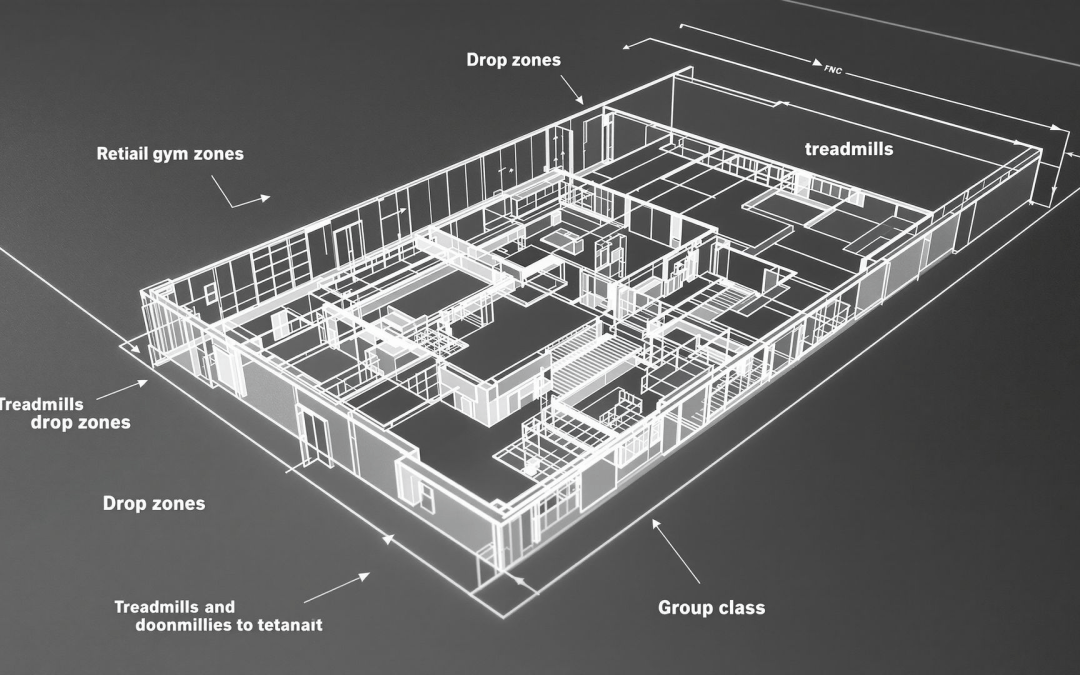
Existing floors are not always built for heavy or dynamic live loads. When a tenant build-out or change of use introduces rhythmic movement, dropped equipment, concentrated point loads, or heavy machinery, the floor that worked fine for a retail shop or office may not be adequate without a closer look. A structural engineer can determine whether an existing floor system can safely carry the new load, identify the parts of the building most at risk, and recommend reinforcement or isolation only where it is actually needed. Here is what that assessment typically covers.
What Makes Dynamic and Impact Loads Different
Dynamic, rhythmic, and impact loads behave differently than the steady loads a floor was originally designed to check against code minimums. Some sources engineers commonly evaluate:
- Dynamic loads: Rhythmic footfall from group activity, synchronized movement, or cyclical machine operation induces accelerations that affect comfort and equipment performance.
- Impact loads: Dropped equipment, tools, or materials create short-duration, high-magnitude forces that can excite floor vibration and travel as structure-borne noise.
- Concentrated loads: Racking, storage systems, mechanical units, and heavy fixtures impose localized bearing demands on slabs and framing.
- Higher live loads: Some uses require higher live loads than the occupancy the floor was originally designed for. Confirm applicable live load requirements and occupancy classification with the local building department before finalizing a layout.
The goal is not just meeting strength requirements; it is achieving serviceability—controlling deflection and vibration for a stable, predictable floor.
High-Load Zones: Identify and Treat
Not all square footage sees the same demand. A thoughtful layout reduces risk before any reinforcement is considered.
Common sources of concentrated or dynamic loading
- Fitness or studio uses (synchronized movement, dropped weights, group activity)
- Mechanical, production, or packaging equipment with cyclical operation
- Material handling zones (pallet jacks, carts, rolling equipment)
- Storage or racking areas with concentrated point loads
- Assembly or gathering spaces with crowd movement
Assessment and performance criteria
A structural engineer will:
- Review as-built drawings to determine floor framing, spans, and stiffness.
- Conduct site surveys: slab thickness, deck rib direction, joist spacing, and existing supports.
- Perform analytical modeling and/or field vibration testing (using accelerometers) to quantify frequency, damping, and RMS accelerations.
- Compare results with recognized floor vibration design guidance and human comfort criteria for the intended use.
Mitigation hierarchy
- Plan location wisely: Place impact-heavy activity on-grade or over the stiffest framing bays. Avoid long-span or flexible areas for heavy or repetitive loading.
- Stiffen the structure: Increase floor frequency to shift away from excitation ranges common in footfall and equipment use.
- Isolate sources: Use floating floors, resilient mounts, and isolation blocks under equipment.
- Operational controls: Limit drop heights, use technique mats, distribute loads across platforms, and set occupancy or use limits for upper levels.
Combinations are common—isolated platforms over a stiffened bay, for example.
Floor Systems and Reinforcement Strategies
Every structural system behaves differently under dynamic loads. Understanding what is already in place is the first step to reinforcing it effectively.
Typical existing conditions and considerations
- Concrete slab on grade: Handles impacts well; minimal vibration concerns. Focus on localized bearing and surface protection.
- Concrete slab on metal deck (composite): Good strength but can be lively on long spans. Pay attention to deck rib direction and concentrated loads.
- Post-tensioned (PT) slabs: Strong and efficient yet sensitive to drilling and coring. Always scan and follow strict anchoring protocols.
- Steel-framed floors with concrete topping: Potentially flexible; often need added stiffness or isolation measures for dynamic use.
- Timber or wood joist floors: Light and vibration-prone; generally poor candidates for heavy-impact zones on upper floors.
Reinforcement and upgrade options
- Localized stiffening
- Add beams or sister members under critical bays to shorten spans.
- Install steel channel strongbacks under joists to distribute loads and raise frequency.
- Introduce jack posts or columns to reduce unsupported lengths (coordinate with egress and architectural constraints).
- Surface and load distribution
- Thickened, high-density rubber over structural plywood or composite sheathing.
- Isolated platforms with layered assemblies (mass plus resilient layer plus finish).
- Steel or thick plywood bearing plates beneath heavy fixtures to spread point loads.
- Structural overlays and bonding
- Thin concrete topping (where weight and headroom permit) to add mass and stiffness.
- Fiber-reinforced polymer (FRP) strengthening on beams or slab soffits (engineer-of-record design required).
- Floating floors and isolation
- Resilient pads or spring-isolated subfloors tuned to avoid resonance with activity frequencies.
- Sprung floors to balance energy return and occupant comfort where applicable.
Note: Standard rubber tiles alone rarely solve structure-borne vibration from heavy drops. They work most effectively as part of a layered assembly with mass and resilient isolation.
Concentrated loads and anchorage
- Verify strut locations and load paths for heavy equipment frames and storage racks.
- Provide bearing plates or sleepers to distribute concentrated loads over deck ribs and joists correctly.
- For anchors, scan slabs (GPR) to avoid PT tendons, conduits, and rebar. Use engineered adhesive or mechanical anchors with proper edge distances and embedment. Obtain approvals before drilling.
Ceiling Clearance and Overhead Loads
Ceilings are more than an aesthetic decision in a heavy-use tenant space—clearances and the structure above influence layout options and safety.
Plan clearances for equipment and MEP
- Overhead rigging, hoists, or hanging fixtures: clear height needs vary by use—coordinate early with your architect and structural engineer.
- Large fans (HVLS), ductwork, lighting grids, and acoustic treatment all compete for space. Use coordination models to avoid conflicts and keep air paths clear over high-activity areas.
Always confirm local fire and life safety requirements. Maintain required clearance to sprinkler deflectors and coordinate with the authority having jurisdiction to ensure compliance.
Overhead anchorage and dynamic effects
- Overhead anchors (hoists, rigging, hanging equipment) create dynamic tension and potential shock loads that exceed static weight. Design anchors and supporting structure accordingly.
- Use dedicated steel members or embed plates rather than relying on drywall ceilings or light-gauge framing.
- Provide lateral bracing to limit sway. Verify that added bracing does not compromise mechanical or sprinkler coverage.
Managing Noise and Structure-Borne Sound
Vibration and noise are linked. What you feel underfoot often becomes what neighbors hear through walls and ceilings.
- Increase separation: Position impact zones away from party walls and sensitive adjacent tenants.
- Control flanking: Detail slab edges, penetrations, and wall or floor intersections to reduce indirect transmission paths.
- Build in mass and decoupling: Heavier floor assemblies with resilient layers perform better against low-frequency thumps. Use resilient ceiling hangers below noisy zones where needed.
- Commission acoustic tests where warranted: For mixed-use buildings, an acoustical consultant can help set and verify targets for impact and airborne sound performance.
A structural engineer and acoustical consultant working together can help align stiffness, mass, and isolation strategies from the outset.
Pre-Build-Out Checklist
Before signing a lease or starting construction, gather this information. A structural engineer can also help prepare the permit drawings and calculations a build-out typically requires.
- Obtain structural drawings, live load ratings, and any past reinforcement records.
- Verify floor system type, spans, slab thickness, and deck direction.
- Identify high-load or high-vibration areas in your program and locate them over the stiffest bays.
- Commission preliminary vibration assessments or field tests if locating heavy or dynamic loads above grade.
- Scan for PT tendons, rebar, and services before any coring or anchoring.
- Confirm ceiling clear heights against your equipment and layout plan.
- Coordinate with MEP and fire protection early—sprinkler coverage and ductwork can limit usable height.
- Plan operational policies that complement the structural solution.
When to Hire a Structural Engineer
Engage a structural engineer at concept stage if any of the following apply:
- You are placing heavy equipment, dense storage, or activity areas with synchronized or repetitive movement above grade.
- The building uses long-span steel, light wood framing, or slender composite slabs.
- You anticipate overhead equipment, heavy racks, or specialized anchorage.
- There are sensitive neighbors, residential or otherwise, adjacent or below.
- You need to confirm or increase live load ratings, or you are changing occupancy type.
Early involvement helps you plan the layout, target reinforcement where it is actually needed, and avoid delays. A pre-build-out structural inspection is often the fastest way to know what a floor can actually carry.
Practical Tips for Managing Dynamic Floor Loads
- Put the heaviest or noisiest activity on grade where possible.
- Use isolated platforms and distribute heavy fixtures to avoid clustering impacts.
- Stiffen first, then isolate—the combination gives better control of low-frequency vibration.
- Design for maintenance: keep access open to isolation components, anchors, and equipment bases.
- Document operating rules and include them in tenant agreements.
- Pilot test a small zone: instrument it, adjust assemblies, and confirm performance before scaling up.
In Green Bay and Manitowoc, many of the buildings being considered for a heavier or more dynamic tenant use are older structures on slab-on-grade foundations that have gone through many winters of freeze-thaw cycling. That cycling can affect slab bearing and floor levelness, both of which matter when a new dynamic or concentrated load is being planned. Wisconsin’s heavy snow loads are also a factor whenever a build-out adds rooftop mechanical equipment to support the new use, since that equipment adds weight the roof structure has to carry through winter.
Conclusion
Bouncy floors, rattling fixtures, and noise complaints usually trace back to a floor that was never checked against the load it is now being asked to carry. With the right assessment, modeling, and targeted reinforcement, an existing floor can often support a heavier or more dynamic use without a full structural rebuild. The key is to confirm the building’s actual capacity before build-out begins, design for the real dynamic loads involved, and add isolation where it matters most.
Structural Engineering in Northeast Wisconsin
Curva Consultants provides floor load assessments, vibration and deflection evaluations, and structural reinforcement design for tenant build-outs and changes of use for residential, commercial, industrial, and municipal projects, working in wood, steel, concrete, and masonry. The principal engineer holds Wisconsin PE License No. 47224.
Offices are in Green Bay and Manitowoc, with regular work in De Pere, Ashwaubenon, Allouez, Howard, Suamico, downtown Green Bay, the Appleton area, and the Sheboygan area.
If you are planning a build-out or change of use that will add heavy or dynamic loads to an existing floor, get in touch or call 866-455-0155. A full list of services is on the structural engineering services page.
Frequently Asked Questions
Why do dynamic and rhythmic loads need structural review?
Repetitive movement, dropped equipment, and heavy fixtures impose loads beyond what most floors were originally designed to check against. A structural engineer evaluates strength and serviceability—frequency, deflection, damping—so layouts, reinforcement, and isolation meet code and comfort requirements. Reviewing this before build-out helps avoid later retrofits.
How does a structural engineer identify high-load zones?
The engineer maps existing framing, tests or models vibration, and compares results to recognized comfort criteria for the intended use. Mitigations include placing heavy or repetitive loads on the stiffest bays, stiffening critical framing, isolated platforms, tuned floating floors, and operational controls such as limiting drop heights.
What floor reinforcement strategies work for above-grade heavy or dynamic use?
Options include adding beams or strongbacks to shorten spans, jack posts or columns, composite or concrete toppings for added mass, FRP strengthening, and bearing plates under heavy fixtures. Layered platforms combining mass and resilient isolation are common. A structural engineer designs the anchors and upgrades to match the actual load.
How should ceiling clearance and overhead anchors be designed for heavy equipment?
Plan clear heights around the equipment or activity involved while preserving sprinkler clearance and airflow. Overhead anchors see dynamic and shock loads well beyond static weight, so they need dedicated steel or embed plates, proper bracing, and engineered fasteners rather than light-gauge framing.
How can a tenant or building owner manage noise and structure-borne vibration for neighbors?
Structure-borne sound travels through floors and walls. Reducing complaints usually means separating heavy-load zones from sensitive tenants, adding mass with resilient layers, isolating ceilings, and detailing edges to prevent flanking. A structural engineer and an acoustical consultant working together can set and verify realistic performance targets.
When should I hire a structural engineer for a tenant build-out involving heavy or dynamic loads?
Hire a structural engineer at concept stage if you are placing heavy equipment or repetitive-motion activity above grade, working with long-span or wood framing, modifying a post-tensioned slab, adding overhead anchorage, or located near sensitive neighbors. Also engage one when changing occupancy or verifying live load ratings.
What should I check before leasing or building out a space with heavy floor loads?
Before leasing or construction, obtain structural drawings and live load ratings, confirm slab type and spans, scan for PT tendons and utilities, and identify where the heaviest or most dynamic loads will sit relative to the stiffest framing. Validate ceiling clearances against your equipment plan and allow time for any needed reinforcement or isolation work.