
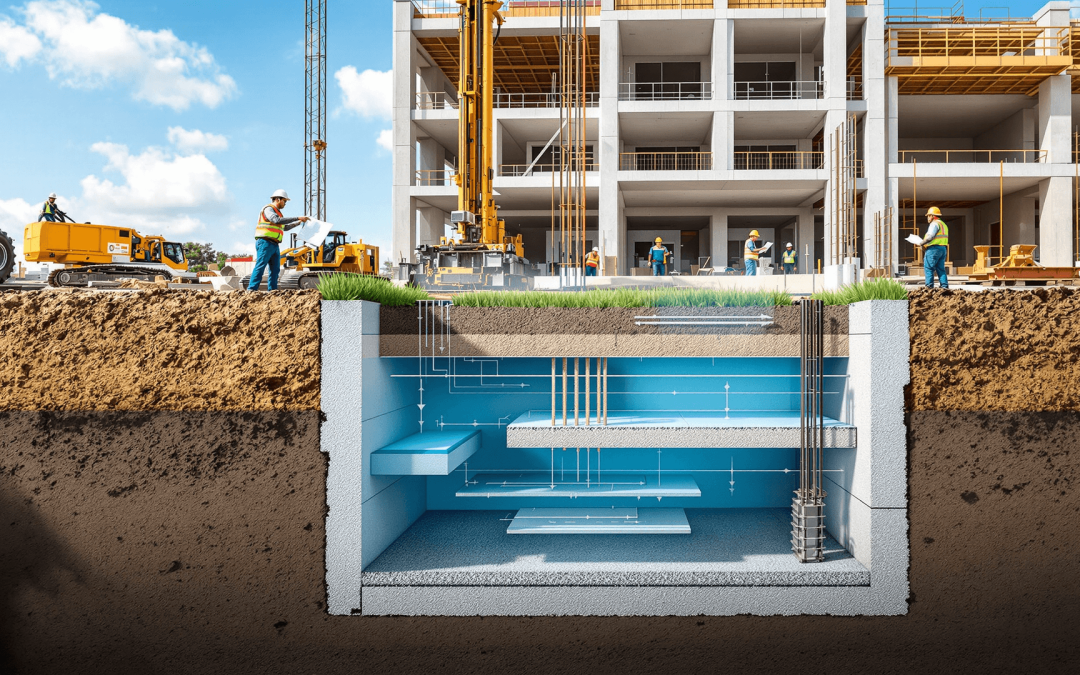
From concept through construction, a high-performance commercial foundation starts with the ground beneath it. Soil behavior, site conditions, and slab selection all interact to determine performance and risk. Early involvement from a structural engineer—working alongside a geotechnical engineer—helps align foundation decisions with building loads, schedule, and long-term resilience. If you’re planning a new facility or expansion, this guide clarifies how soil tests inform settlement risk, how to choose the right foundation system, and when to hire a structural engineer to protect your project.
Why Soil Rules the Foundation
Your foundation doesn’t just support the building—it mediates the building’s relationship with its site for the long term. The soil profile controls bearing capacity, settlement, drainage, and durability. Variable fill, expansive clays, collapsible sands, high groundwater, or weak organic layers can all influence which structural solution fits. Getting soil parameters wrong risks slab cracking, door misalignment, facade distress, and utility breaks. Getting them right supports a smoother schedule and a foundation that performs as intended.
Key outcomes that flow from the soil profile:
- Bearing capacity and allowable loads for footings, mats, or piles
- Total and differential settlement expectations
- Liquefaction and lateral spreading potential (in seismic zones)
- Frost susceptibility, shrink-swell movement, and heave risk
- Groundwater impacts on buoyancy and construction dewatering
- Corrosivity and sulfate attack potential affecting concrete and steel
Start with a Geotechnical Investigation
A thorough subsurface exploration is the cornerstone of foundation design. Before committing to a slab type or footing depth, insist on a site-specific geotechnical report. Work with a structural engineer to ensure the scope captures your building’s needs.
Typical field and lab investigations:
- In-situ tests: Standard Penetration Test (SPT), Cone Penetration Test (CPT), vane shear
- Borings and test pits to identify stratigraphy, fill, and organics
- Groundwater monitoring wells or piezometers for seasonal variation
- Laboratory tests: grain size, Atterberg limits, consolidation (oedometer), triaxial or direct shear, corrosion index, sulfate/chloride content
- Chemical screening for contaminants (where redevelopment or industrial history exists)
Deliverables to request:
- Recommended allowable bearing pressures for shallow foundations
- Anticipated total and differential settlements under service loads
- Subgrade modulus and parameters for slab-on-grade design
- Lateral and uplift resistance for deep foundations
- Seismic site class, liquefaction screening, and ground improvement recommendations
- Frost depth, drainage guidance, and corrosion exposure categories
Define Performance Early: Settlement and Serviceability
Foundation performance is rarely governed by ultimate strength alone. Serviceability—especially settlement control—drives long-term satisfaction and operating performance.
Set clear criteria up front:
- Total vs. differential settlement limits (e.g., differential ≤ 1/2 inch over 40 ft for typical office/retail; more stringent for precision manufacturing or racking)
- Floor flatness/levelness (FF/FL) targets for slab-on-grade
- Tolerance for crack widths and joint behavior
- Vibration criteria for labs, healthcare, or sensitive equipment
- Waterproofing limits for below-grade spaces
Partner with your structural engineer to translate performance targets into foundation type, slab system, and grading/drainage strategy. When in doubt, hire a structural engineer early—before value-engineering erodes performance margins.
Choosing the Right Foundation System
Foundation selection is a matter of matching the system to soil, loading, and risk—not choosing one universal solution. Consider the following categories.
- Shallow Foundations (Spread Footings and Mats)
- Well suited to competent soils with moderate bearing capacity and limited settlement risk.
- Generally faster to build than deep foundation systems.
- Use combined footings or grade beams where column spacing is tight or loads are heavy.
- Mat foundations suit heavy loads over variable soils, spreading load across the footprint to control differential settlement.
- Deep Foundations (Driven Piles, Drilled Shafts, Micropiles)
- Appropriate for weak near-surface soils or strict settlement limits.
- Transfer loads to deeper competent strata via end-bearing and/or skin friction.
- Micropiles excel on constrained sites or retrofits with limited headroom.
- Verify capacity via load testing; coordinate pile driving with noise/vibration constraints.
- Ground Improvement + Shallow Systems
- Improve subgrade to make shallow foundations feasible: stone columns, vibro-replacement, dynamic compaction, soil mixing, grouting, geogrids/geotextiles.
- Often reduces differential settlement and construction risk without going fully deep.
- Hybrid Systems
- Combine ground improvement with a mat foundation, or use pile-supported structural slabs in selective zones (e.g., under heavy equipment).
- Useful where uniform performance is required across a variable soil profile.
Schedule and constructability matter as much as technical suitability. A structural engineer can help weigh the full picture—construction effort, risk, and long-term maintenance—rather than focusing only on the initial scope alone.
Slab-on-Grade: More Than a Flat Surface
Selecting the right slab system is crucial for performance, especially in warehouses, retail, and healthcare facilities.
Common systems:
- Conventional slab-on-grade
- Reinforced for temperature/shrinkage; suitable for moderate loads and rack systems with adequate subgrade support.
- Post-tensioned (PT) slab
- Controls cracking and curling while spanning over localized soft spots; valuable in expansive clays and for high flatness needs.
- Structural slab (slab-on-piles)
- Isolated from problematic soils; avoids slab settlement in exchange for added structure and detailing.
Design considerations:
- Subbase quality and uniformity: well-graded, compacted, with proper moisture conditioning.
- Vapor retarder/barrier placement: under-slab placement affects curling and moisture emissions; coordinate with flooring warranties.
- Joint design: spacing, load transfer (dowels), and sealants tailored to traffic, forklifts, and racking.
- Curling and shrinkage control: PT, low-shrinkage mixes, optimized aggregate gradation, and curing practices.
- Floor flatness/levelness: specify FF/FL criteria aligned with equipment needs and QA testing methods.
Water, Drainage, and Frost
Water is a primary driver of foundation distress. Design to keep it out, off, and away.
- Site grading: slope away from buildings (typically 5% for first 10 ft where feasible).
- Subsurface drainage: perimeter drains, under-slab drainage layers, and sump systems where groundwater is high.
- Waterproofing: select systems matched to hydrostatic pressure and soil chemistry; protect membranes during construction.
- Frost protection: found below local frost depth or use frost-protected shallow foundations with insulation details.
- Heave mitigation: in expansive clays, manage moisture with capillary breaks, controlled landscaping/irrigation, and PT slabs where appropriate.
Frost and clay soils are a significant local factor in Northeast Wisconsin. Frost depth in the Green Bay and Manitowoc area typically runs in the range of 42 to 48 inches, and footings placed above that depth risk frost heave that can crack slabs and shift foundation walls over repeated freeze-thaw cycles. Many sites in the region also sit on clay-rich soils that shrink and swell with seasonal moisture, which is part of why a site-specific geotechnical investigation matters more here than a generic regional assumption. Spring snowmelt and a seasonally high water table add another layer that a structural engineer accounts for when detailing drainage and waterproofing.
Construction Quality and Verification
Even a sound design fails with poor execution. Build quality into the plan.
- Preconstruction coordination: align geotechnical, structural, and contractor interpretations of the report and drawings.
- Subgrade proof-rolling and acceptance criteria before placing subbase.
- Field density/moisture testing for fills and subbase layers.
- Concrete QA: mix design verification, slump/temperature/air tests, cylinders, and strength reports.
- Pile or shaft QC: driving logs, PDA testing, static load tests, integrity testing for drilled shafts.
- Instrumentation (as needed): settlement plates, inclinometers, or piezometers to validate assumptions on critical projects.
Sealed structural drawings and calculations tie these steps together for the permit and inspection process.
Sustainability and Long-Term Performance
High-performance foundations can support sustainability goals without unnecessary overbuilding.
- Optimize quantities: mats vs. many footings; PT slabs to reduce thickness; ground improvement to avoid deep foundations.
- Concrete durability: mix for exposure class, supplementary cementitious materials to reduce cement content, and corrosion-resistant reinforcement where needed.
- Lifecycle view: weigh upfront construction effort against settlement risk, downtime, and repair likelihood.
When to Hire a Structural Engineer
You should hire a structural engineer:
- Before site purchase or early in due diligence to flag foundation risks.
- When geotechnical variability is high (fills, organics, expansive clays, seismic hazards).
- If the building has heavy point loads, sensitive equipment, tall racking, or strict settlement limits.
- When long-term floor performance (flatness, vibration) is mission-critical.
- If hybrid or advanced systems (PT slabs, mats with ground improvement, pile-supported slabs) are on the table.
- To coordinate value engineering without compromising serviceability or durability.
A structural engineer inspection of an existing foundation is also worth considering before an addition or a significant change in use. Early collaboration between the structural engineer, geotechnical engineer, and contractor is the most reliable path to a foundation that performs on day one and year twenty.
Quick Planning Checklist
- Commission a geotechnical investigation scoped to your building loads and risk profile.
- Define settlement and serviceability targets early; set FF/FL criteria.
- Compare shallow, deep, and ground improvement options against schedule and long-term performance.
- Select a slab system matched to subgrade, loads, and moisture control requirements.
- Design comprehensive drainage and waterproofing details.
- Establish QA/QC protocols and acceptance criteria preconstruction.
- Engage and hire a structural engineer early to align design and performance.
The Bottom Line
High-performance foundations come from understanding the ground, defining performance, and selecting systems that manage risk gracefully. Soil tests inform settlement expectations; settlement criteria drive system choice; and construction quality locks in performance. Bring a structural engineer onto the team early to balance technical demands with pragmatic constructability, and you’ll deliver a commercial site that stays level, dry, and durable well into the future.
Structural Engineering in Northeast Wisconsin
Curva Consultants provides foundation design, geotechnical coordination, structural assessments and inspections, and structural drawings and calculations for residential, commercial, industrial, and municipal projects, working in wood, steel, concrete, and masonry. The principal engineer holds Wisconsin PE License No. 47224.
Offices are in Green Bay and Manitowoc, with regular work in De Pere, Ashwaubenon, Allouez, Howard, Suamico, downtown Green Bay, the Appleton area, and the Sheboygan area.
If you’re planning a new foundation or want an existing one evaluated, get in touch or call 866-455-0155. A full list of services is on the structural engineering services page.
Frequently Asked Questions
What defines a high-performance foundation for commercial buildings?
A high-performance commercial foundation aligns soil conditions, site drainage, and slab design to deliver strength and strict serviceability—minimal differential settlement, flat floors, and durability. It starts with reliable geotechnical data and early collaboration between a structural engineer, geotechnical engineer, and contractor, prioritizing long-term performance, constructability, and quality control.
Which soil tests are essential before choosing a foundation system?
Before selecting a foundation, commission borings with SPT or CPT, groundwater monitoring, and lab tests (grain size, Atterberg limits, consolidation, shear). Request recommendations for bearing capacity, settlement, subgrade modulus, seismic site class, and corrosion. A structural engineer uses these parameters to size footings, mats, piles, and slabs confidently.
How can I assess and control settlement risk on a commercial site?
Set explicit total and differential settlement limits based on occupancy and equipment needs. Reduce risk by choosing mats on variable soils, deep foundations where near-surface soils are weak, or ground improvement to stiffen subgrades. For floors, post-tensioned slabs control cracking and curling. Monitor critical projects with settlement plates as needed.
How do I choose between shallow, deep, or ground-improved foundations?
Compare shallow footings and mats (fast to build) with deep foundations (piles, drilled shafts) and ground improvement or hybrid solutions. Base the choice on soil profile, loads, schedule, and noise/vibration constraints. To balance risk and long-term performance, hire a structural engineer to model options and quantify settlement performance.
Which slab-on-grade option fits my commercial project?
Conventional reinforced slabs suit moderate loads on uniform subgrades. Post-tensioned slabs limit shrinkage, curling, and span soft zones—useful for expansive clays or high flatness needs. Structural slabs on piles isolate floors from problematic soils. Specify subbase quality, vapor barrier location, joints/dowels, and FF/FL criteria aligned with operations.
How should water, drainage, and frost be managed to protect foundations?
Keep water out, off, and away. Grade the site to drain, add perimeter and under-slab drains where groundwater is high, and select waterproofing compatible with soil chemistry and pressure. Place foundations below frost depth or use frost-protected details; manage expansive clays with capillary breaks and moisture control. In Northeast Wisconsin, frost depth and seasonal clay movement make this planning especially important.
When should I hire a structural engineer for foundation design?
Hire a structural engineer during due diligence to flag foundation risks and plan accordingly. Engage them when soils vary, loads are heavy, equipment is sensitive, or hybrid systems (PT mats, pile-supported slabs) are considered. They coordinate with geotechnical data, set serviceability targets, and steer value engineering without sacrificing performance.