
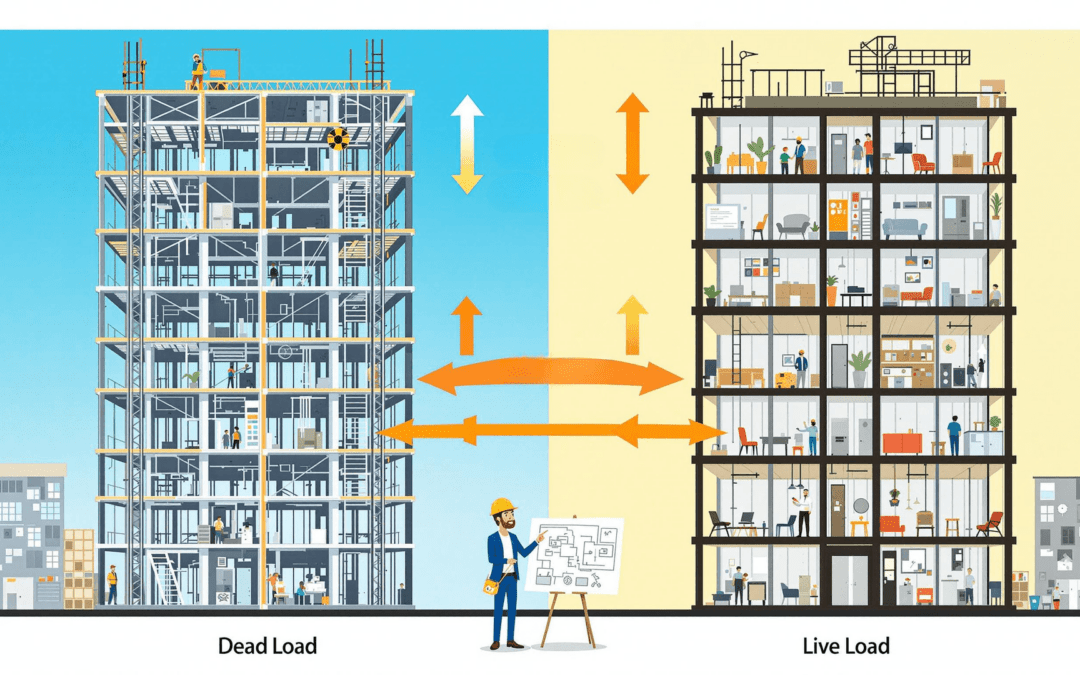
Structural engineering is a critical field that supports the safety and integrity of buildings. Central to this discipline are the concepts of dead loads and live loads, which are essential for anyone looking to hire a structural engineer. Understanding these loads is crucial in designing stable and efficient structures.
What Are Loads in Structural Engineering?
In the context of structural engineering, loads refer to forces or other actions that lead to deformations, stresses, and displacements in a structure. They are essential considerations during the design process to ensure that structures can withstand various forces over time. Loads are generally categorized into two main types: dead loads and live loads.
Understanding Dead Loads
Dead loads are the permanent or static forces acting on a structure. They primarily consist of the weight of the construction materials themselves. The importance of dead loads lies in their constancy, as they do not change over time, making them predictable for structural analysis.
Components of Dead Loads
- Construction Materials: The weight of floors, walls, roofs, and other structural components.
- Fixed Fixtures: Includes immovable parts such as plumbing, electrical installations, and built-in cabinets.
- Permanent Additions: These might include elements like flooring finishes or permanently installed furniture.
The accurate calculation of dead loads is vital because it directly influences the structural integrity and design efficiency. When you hire a structural engineer, ensuring they provide precise dead load calculations can help optimize material use.
Understanding Live Loads
Unlike dead loads, live loads are transient and variable forces acting on a structure. They account for the movable items within a building and any temporary forces it may encounter.
Components of Live Loads
- Occupant Weight: The weight of people and animals using the space.
- Furniture and Equipment: Movable items like desks, chairs, machinery, or any non-permanent fixture.
- Environmental Factors: Includes snow, wind, and seismic activities, which can affect a building at various times.
Importance of Live Loads
The unpredictable nature of live loads requires careful consideration to ensure safety under varying conditions. By hiring a structural engineer, you benefit from expert evaluations of potential live loads, ensuring that your structure can accommodate these changes without compromising safety.
Differences Between Dead Load and Live Load
- Permanency: Dead loads are constant, whereas live loads vary over time.
- Calculation: Dead loads are easier to calculate due to their constancy, while live loads require estimations and may need adjustments based on usage.
- Impact on Design: Both loads impact material selection and structural design, but live loads demand more flexibility to accommodate changes.
Snow Load in Wisconsin
In northeast Wisconsin, snow is often the live load that governs a roof design. What accumulates on the roof matters, and so does drifting where a lower roof meets a taller wall or a parapet. Two buildings with identical framing can need different roof members depending on how snow collects on them, which is why a roof that has stood for years can still be worth checking before adding load to it.
Why Accurate Load Calculations Matter
Accurate load calculations are crucial for a structure’s longevity, safety, and efficiency. A professional structural engineer can provide these calculations, offering a blueprint that enhances the building’s response to both expected and unexpected forces. Ensuring precise load assessments can prevent structural failures and reduce repair and maintenance needs over time.
When Load Calculations Need a Licensed Engineer
Most everyday framing is already covered by prescriptive code tables, and a contractor can build straight from them. Once a project steps outside those tables, the tables stop answering the question. Common triggers:
- Removing or opening up a load-bearing wall
- An addition tying new structure into existing structure
- A change of use that raises the live load a floor has to carry
- Mezzanines, equipment platforms, or machinery set on or hung from existing framing
- Commercial and multi-story work, where prescriptive tables generally do not apply
In those situations a building department will usually ask for drawings and calculations prepared and stamped by a licensed professional engineer. Here is what that package includes and how to keep plan review moving.
If the question is about a building that already exists rather than one being designed, the starting point is usually a structural engineer inspection. Where storm, fire, or impact damage is involved, that becomes forensic engineering and damage investigation.
Structural Engineering in Northeast Wisconsin
Curva Consultants prepares structural drawings and calculations and performs structural assessments for residential, commercial, industrial and municipal projects, working in wood, steel, concrete and masonry. The principal engineer holds Wisconsin PE License No. 47224.
Offices are in Green Bay and Manitowoc, with regular work in De Pere, Ashwaubenon, Allouez, Howard, Suamico, downtown Green Bay, the Appleton area and the Sheboygan area.
To talk through a project, get in touch or call 866-455-0155. A full list of services is on the structural engineering services page.
Frequently Asked Questions
What are loads in structural engineering?
In structural engineering, loads are forces or actions causing stress and displacement in structures. They are crucial for designing stable buildings and come in two main types: dead loads, which are static, and live loads, which are variable.
What is a dead load?
A dead load refers to permanent forces acting on a structure, mainly due to construction materials like beams, walls, and roofs. Since they are constant, they are predictable and crucial for the structural design.
What is a live load?
A live load consists of variable forces on a structure, such as occupants, furniture, and environmental factors like snow and wind. These loads are crucial for design and require careful consideration due to their unpredictable nature.
How do dead loads and live loads differ?
Dead loads are static and constant, whereas live loads are dynamic and change over time. Both affect material selection and design, but live loads demand more flexibility in design to accommodate changes.
Why are accurate load calculations important?
Accurate load calculations are vital for a building’s safety and longevity. They ensure structures withstand forces without failure. Hiring a structural engineer supports precise load assessments, reducing potential risks.
Does my project need stamped structural calculations?
Every municipality writes its own submittal requirements, so the building department handling your permit is the authoritative answer. As a rule, work that steps outside the prescriptive code tables — wall removals, additions, wide openings, changes of use, mezzanines and most commercial work — is where stamped drawings and calculations get requested.