
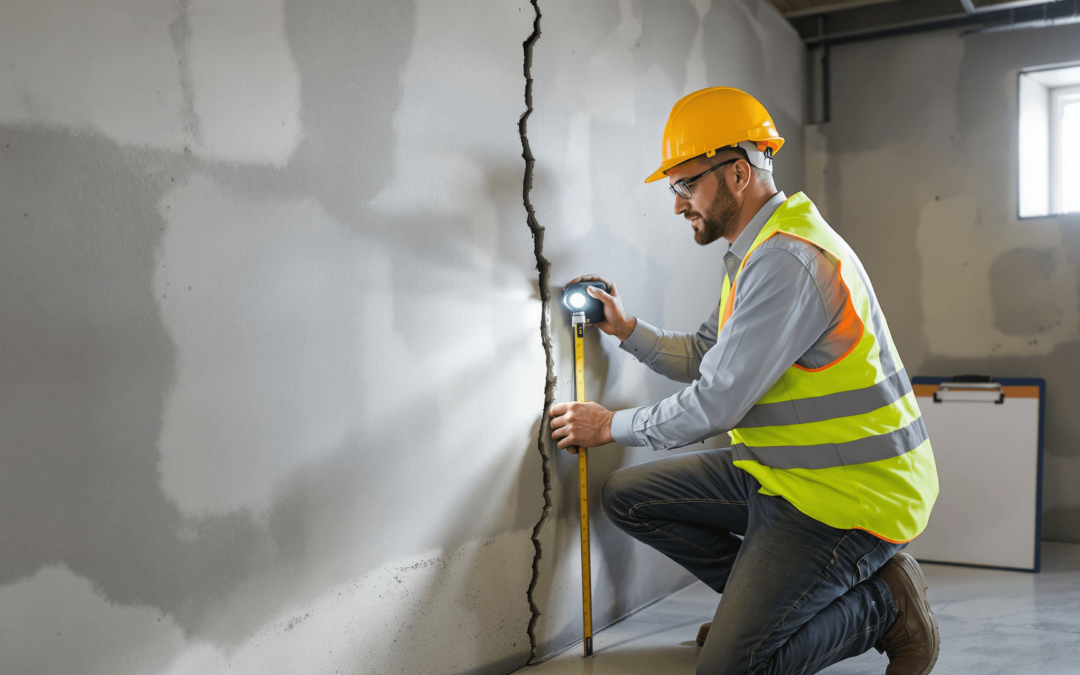
Foundation cracks are common, and most of them are not an emergency. The useful question is which ones matter. This guide explains how to tell a cosmetic crack from a structural one, what to do while you are deciding, and when to bring in a structural engineer.
Common Types of Foundation Cracks
- Hairline shrinkage cracks — thin, surface-level cracks in new concrete from curing. Usually cosmetic and stable.
- Vertical cracks — often from natural settling; typically less worrying if narrow and not growing.
- Diagonal cracks — can indicate differential settlement, where one area sinks more than another. More concerning if widening or paired with sticking doors and windows.
- Horizontal cracks — a red flag in basement or crawlspace walls. These often signal pressure from soil or water and usually warrant evaluation by a structural engineer.
- Stair-step cracks in masonry — follow the mortar joints in block or brick. A potential sign of settlement or lateral pressure.
- Map or spider cracking — a surface-only network of fine lines, often cosmetic unless moisture intrusion is present.
Why Wisconsin Foundations Crack
Northeast Wisconsin puts a particular set of forces on a foundation. Freeze-thaw cycling works on concrete and mortar every winter. Clay-heavy soils swell when wet and shrink when dry, which moves footings unevenly. Spring water tables push laterally against basement walls, and that lateral pressure is what produces the horizontal cracking and wall bowing that matters most.
This is why a crack that has been stable for years can start moving after one wet spring or one hard freeze, and why the season a crack appears in is part of the diagnosis.
Warning Signs You Should Not Ignore
- Cracks wider than 1/8 inch (about 3 mm), or cracks that are suddenly widening
- Horizontal cracks, bowing walls, or bulging sections
- Cracks that leak water or show efflorescence, the white powdery residue left by moisture
- Doors or windows sticking, gaps opening at trim, or latches no longer lining up
- Floors that slope, bounce, or feel uneven
- Repaired cracks that reopen, or new cracks appearing after heavy rain or a hard freeze
- Significant separation at corners or where walls meet the ceiling
What to Do Before You Call
None of this is a repair — it is information gathering, and it makes the engineering assessment faster and more accurate when you do call.
- Document and monitor. Mark the ends of each crack with a pencil and write the date next to it. Photograph the crack with a ruler or coin in frame for scale, and recheck monthly.
- Measure the width. A crack gauge or a set of calipers gives you a number you can compare over time. Movement matters more than any single measurement.
- Look at where water goes. Clogged gutters and downspouts that discharge right at the foundation are the most common aggravating factor, and the easiest to notice.
- Note what changed. A new crack after a wet spring, a drought, a hard freeze, or nearby excavation is a useful clue about the cause.
Structural repairs themselves are not a homeowner job. Anything involving bracing, underpinning, or altering a load-bearing element needs an engineered design behind it.
When to Bring In a Structural Engineer
If you see horizontal cracks, bowing walls, rapidly changing cracks, or several structural symptoms together — sticking doors, sloped floors, widening cracks — that is the point to bring in a structural engineer.
Because an engineering practice does not sell the repair work, the assessment is independent. The report is a professional opinion you can hand to a contractor, a lender, an insurance carrier, or a building official.
What an assessment involves:
- On-site evaluation of the foundation, framing, floors, and exterior grading
- Measurements, photographs, and moisture evaluation
- A written report covering cause, severity, and recommended repairs
- Where the situation calls for it, stamped drawings and specifications to guide the contractor
- Follow-up verification after repairs are complete
There is more on what to expect in our guide to structural engineer inspections in Green Bay and Manitowoc.
Why Repairs Differ So Much From One House to the Next
There is no standard answer to what a foundation repair involves, because the repair follows the cause. A crack from concrete shrinkage, a crack from differential settlement, and a crack from lateral soil pressure are three different problems that happen to look similar on the wall. Diagnosing which one you have is what determines the right repair — and it is the step most often skipped.
Repair Approaches in Brief
- Epoxy crack injection — bonds structural cracks in dry conditions and restores strength.
- Polyurethane crack injection — seals actively leaking cracks; flexible and water-resistant.
- Tuckpointing and masonry repair — replaces failing mortar, often paired with drainage work.
- Carbon fiber straps or steel braces — stabilize bowing basement walls with minimal intrusion.
- Wall anchors or helical tiebacks — counteract lateral soil pressure where bowing is significant.
- Helical or push piers (underpinning) — transfer load to stable soil or bedrock to correct settlement.
- Drainage and waterproofing — exterior grading, drain tile, sump pumps, and membranes reduce hydrostatic pressure.
Keeping Water Away From the Foundation
Most foundation problems in this region are water problems first.
- Keep gutters clear and extend downspouts well away from the house
- Grade the soil so it slopes away from the foundation rather than toward it
- Avoid heavy irrigation directly against the foundation wall
- Plant large trees an appropriate distance from the house
- Look things over seasonally, and again after severe weather
Structural Engineering in Northeast Wisconsin
Curva Consultants performs structural assessments and foundation evaluations for homes and commercial buildings from offices in Green Bay and Manitowoc, with regular work in De Pere, Allouez, Howard, Suamico, Ashwaubenon, the Appleton area, and the Sheboygan area. The principal engineer holds Wisconsin PE License No. 47224.
Where cracking follows storm, flood, or impact damage, that becomes forensic engineering and damage investigation, and you can hire your own structural engineer to document it for a claim.
To have a foundation looked at, get in touch or call 866-455-0155.
Frequently Asked Questions
Is it safe to live with foundation cracks?
Many are cosmetic and stay that way for the life of the house. Cracks that are widening, running horizontally, or letting water in are the ones that warrant prompt evaluation.
Which foundation cracks are actually serious?
Horizontal cracks, cracks widening beyond about 1/8 inch, diagonal cracks paired with sticking doors or sloped floors, stair-step cracking through block, and any crack leaking water. Those warrant a professional evaluation to establish the cause.
Should I call a contractor or an engineer first?
An engineer first, for an independent diagnosis, then contractor bids based on the engineer’s plan. That way every bid answers the same defined scope rather than each contractor diagnosing the problem differently.
What should I do the day I notice a crack?
Photograph it with something in frame for scale, mark and date the ends, and note anything that recently changed — a wet spring, a hard freeze, new excavation nearby. Then check whether gutters and downspouts are moving water away from the foundation.
Will insurance cover foundation repairs?
Often not, unless the damage stems from a covered peril such as a sudden pipe burst. Coverage is determined by your carrier and your policy. An engineer documents the cause and extent of the damage; a claims adjuster determines what is covered.
What repair approaches might an engineer recommend?
Epoxy injection for structural bonding, polyurethane injection for active leaks, tuckpointing for masonry, carbon fiber straps or steel braces for bowing walls, wall anchors or tiebacks for lateral pressure, underpinning with piers for settlement, and drainage or waterproofing work. The recommendation follows the root cause.
How do I keep it from happening again?
Manage water. Keep gutters clear, extend downspouts, grade soil away from the house, and avoid saturating the ground right against the foundation. Look things over seasonally and after severe weather, and have movement evaluated if monitoring shows a crack growing.